Tuesday, June 29, 2010
ARI on TV!
NHK (Japanese national public television) just aired a 5-minute segment on ARI! I think the reporters did a good job describing the central mission of ARI, so please watch! I make a very brief appearance about half-way into the segment - look for a girl wearing red pants and a blue shirt when they switch to the dining hall scene...

Friday, June 25, 2010
A trip south
Ohisashiburi desu - long time no see! I'm now back from two weeks of traveling with my boyfriend, Eric, and I'm ready to give a trip report of my time "in Japan":
We first went to Okinawa, the southern-most islands of the Japanese archipelago famous for their white coral beaches and their people's warm hospitality. I wanted to go to Okinawa for two reasons. First, I had never been to the tropics, and, as I planned this trip on cold March evenings, I found that the pictures of coral and white beaches and transparent turquoise water had an irresistible attraction. Second, I had heard that the culture of the islands was very different from that of mainland Japan - that the food was more Chinese than Japanese in taste, that the traditional music was different, that people were supposed to be more open - so I wanted to see this "other" part of Japan.
Okinawa occupies an interesting place in Japanese history. The islands originally formed an independent kingdom, known as the Ryukyu Kingdom, with its own people (the Ryukyu people, who are believed to share a common ancestor with the mainland Japanese people - although the identify of this ancestor is still hotly debated) and its own cultures and languages. For most of its history, the Ryukyu Kingdom was a tribute state of China - its principle commercial and cultural ties were thus with Beijing rather than with Tokyo. The Ryukyu Islands only became part of Japan in 1879, when the Meiji government forcibly annexed the islands and renamed the Kingdom the Okinawa Prefecture. Ever since annexation, the relationship between Okinawa and mainland Japan has been difficult. Okinawans faced discrimination from mainland Japanese throughout the prewar period, as many mainland Japanese felt the Ryukyu people were ethnically inferior to the "pure" Yamato people of the main islands; traditional Okinawan languages and culture almost disappeared due to Tokyo's efforts to impose the Japanese language and cultural identity on the islanders. During World War II, the islands saw the infamous Battle of Okinawa, which cost the lives of over 100,000 American and Japanese soldiers and an almost equal number of Okinawan civilians (about one-quarter of the prewar population), who were ordered by the Japanese government to kill themselves and their families rather than surrender to the American forces. After the war, Okinawa remained under the exclusive jurisdiction of the U.S. military for an incredible 20 years longer than the rest of Japan, due to the strategic importance of Okinawa as the United States' military foothold in the Pacific - many Okinawans believed that Tokyo in fact sacrificed Okinawa to the United States in order to end the Allied occupation of mainland Japan in 1952. The relationship between Okinawa and Tokyo remains tense due to these longstanding disagreements over the American military presence in Okinawa, which today accounts for over ten percent of total land usage on the islands. One American base in particular, Futenma Marine Air Corps Station near the prefectural capital city of Naha, has recently strained relations between Okinawa and Tokyo. Many Okinawans want Tokyo to get Futenma removed from the islands, but Washington will only discuss moving the base to another, less residential location within Okinawa. Prime Minister Hatoyama failed to fulfill his campaign pledge to resolve this issue, and resigned earlier this month as a result.
We spent our first day in Okinawa in Naha. As soon as we stepped out of the Naha airport, we were greeted by the incredible, physical humidity of the tropics - the kind of humidity that you have to swim against, that tastes of the ocean. We were also greeted by the pleasant Naha monorail, the three-car elevated trolley that serves as the main means of public transportation in the capital. After the sleek Metro systems of mainland Japan, with their twenty-car trains with designated "people pushers" for rush times, it was refreshing to visit a city that only needed a three-car capacity for its public transportation system. Already, I sensed that we were in a different Japan.
We spent most of our time in Naha wandering the streets and sampling Okinawan cuisine: mango ice cream, Okinawan soba noodles with pickled ginger, and Okinawan stir-fry with pork and bitter gourd... we declined the specialty chiraga, pig's face. Actually, we found the heat and humidity a little difficult to bear, so we had to do our sight-seeing in short bursts as we scuttled from air-conditioned store to air-conditioned store. And even after one day in Naha, we found that the American military presence was very noticeable - the city was crawling with American soldiers on leave, we heard large jets taking off from nearby Futenma Air Station at least once an hour, and the ubiquitous vending machines had Mug's Root Beer and other American brands that hadn't yet reached the main island.
 Enjoying Okinawan soba noodles
 Naha at night
After Naha, we took a ferry to Zamami Island, a small island about 30 miles from Naha with around 700 residents. Zamami was nothing short of charming. The island's population is centered around the southern port village, which is a labyrinth of quiet houses and overgrown gardens behind crumbling stones walls, and the island itself is a scorched jungle bordered by white coral beaches. Zamami felt very removed from the bustle of Naha - and since we were traveling at the end of the Okinawan rainy season, we had almost the entire island to ourselves! We stayed on the island for four days, exploring the village, the port, and the beaches. The highlight of our Zamami stay was a sea kayaking trip, which included a lunch of traditional Okinawan soba on the beach, snorkeling above a coral forest (I got to see clown fish, sea cucumbers, and star fish!), and a short exploration of an uninhabited island in search of goats - all narrated by our incredibly enthusiastic guide, Mami, who was so amazed by Eric's height that she spent the first five minutes of our orientation comparing her 5' to his 6'4" with ever louder exclamations of surprise and delight.
 Zamami Island
 Snorkeling above the coral forest
 Sea kayaking!
 Eric in China Town
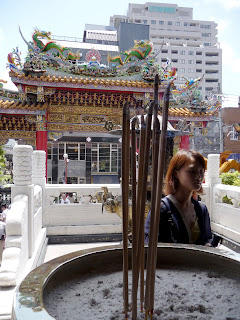 China Town
 Overlooking the port
We first went to Okinawa, the southern-most islands of the Japanese archipelago famous for their white coral beaches and their people's warm hospitality. I wanted to go to Okinawa for two reasons. First, I had never been to the tropics, and, as I planned this trip on cold March evenings, I found that the pictures of coral and white beaches and transparent turquoise water had an irresistible attraction. Second, I had heard that the culture of the islands was very different from that of mainland Japan - that the food was more Chinese than Japanese in taste, that the traditional music was different, that people were supposed to be more open - so I wanted to see this "other" part of Japan.
Okinawa occupies an interesting place in Japanese history. The islands originally formed an independent kingdom, known as the Ryukyu Kingdom, with its own people (the Ryukyu people, who are believed to share a common ancestor with the mainland Japanese people - although the identify of this ancestor is still hotly debated) and its own cultures and languages. For most of its history, the Ryukyu Kingdom was a tribute state of China - its principle commercial and cultural ties were thus with Beijing rather than with Tokyo. The Ryukyu Islands only became part of Japan in 1879, when the Meiji government forcibly annexed the islands and renamed the Kingdom the Okinawa Prefecture. Ever since annexation, the relationship between Okinawa and mainland Japan has been difficult. Okinawans faced discrimination from mainland Japanese throughout the prewar period, as many mainland Japanese felt the Ryukyu people were ethnically inferior to the "pure" Yamato people of the main islands; traditional Okinawan languages and culture almost disappeared due to Tokyo's efforts to impose the Japanese language and cultural identity on the islanders. During World War II, the islands saw the infamous Battle of Okinawa, which cost the lives of over 100,000 American and Japanese soldiers and an almost equal number of Okinawan civilians (about one-quarter of the prewar population), who were ordered by the Japanese government to kill themselves and their families rather than surrender to the American forces. After the war, Okinawa remained under the exclusive jurisdiction of the U.S. military for an incredible 20 years longer than the rest of Japan, due to the strategic importance of Okinawa as the United States' military foothold in the Pacific - many Okinawans believed that Tokyo in fact sacrificed Okinawa to the United States in order to end the Allied occupation of mainland Japan in 1952. The relationship between Okinawa and Tokyo remains tense due to these longstanding disagreements over the American military presence in Okinawa, which today accounts for over ten percent of total land usage on the islands. One American base in particular, Futenma Marine Air Corps Station near the prefectural capital city of Naha, has recently strained relations between Okinawa and Tokyo. Many Okinawans want Tokyo to get Futenma removed from the islands, but Washington will only discuss moving the base to another, less residential location within Okinawa. Prime Minister Hatoyama failed to fulfill his campaign pledge to resolve this issue, and resigned earlier this month as a result.
We spent our first day in Okinawa in Naha. As soon as we stepped out of the Naha airport, we were greeted by the incredible, physical humidity of the tropics - the kind of humidity that you have to swim against, that tastes of the ocean. We were also greeted by the pleasant Naha monorail, the three-car elevated trolley that serves as the main means of public transportation in the capital. After the sleek Metro systems of mainland Japan, with their twenty-car trains with designated "people pushers" for rush times, it was refreshing to visit a city that only needed a three-car capacity for its public transportation system. Already, I sensed that we were in a different Japan.
We spent most of our time in Naha wandering the streets and sampling Okinawan cuisine: mango ice cream, Okinawan soba noodles with pickled ginger, and Okinawan stir-fry with pork and bitter gourd... we declined the specialty chiraga, pig's face. Actually, we found the heat and humidity a little difficult to bear, so we had to do our sight-seeing in short bursts as we scuttled from air-conditioned store to air-conditioned store. And even after one day in Naha, we found that the American military presence was very noticeable - the city was crawling with American soldiers on leave, we heard large jets taking off from nearby Futenma Air Station at least once an hour, and the ubiquitous vending machines had Mug's Root Beer and other American brands that hadn't yet reached the main island.
 Enjoying Okinawan soba noodles
 Naha at night
 Zamami Island
 Snorkeling above the coral forest
 Sea kayaking!
After Zamami, we headed back to the main island of Japan for a brief stop at ARI. Eric worked on the farm for two days as a working visitor - we spent both days in the rice paddies, doing supplemental transplanting and weeding by hand. The first month after transplanting rice largely determines the success of the harvest, so the farm section has to spend many hours in the paddy, carefully removing weeds and millet (a grain that competes with rice) so that the seedlings have space to grow and develop. Tough work, but very important!
 One of eight ARI paddies

Taking a break from the paddy One of eight ARI paddies
After hours in the paddy, we were ready for the second leg of our vacation, a trip down to Yokohama. Just 20 miles south of Tokyo, Yokohama is a lovely city with shady parks, a lively port, interesting neighborhoods, and a very international feel, as the port has been a center of foreign commerce ever since the forced opening of Japan by Admiral Perry in 1853. In our three days in Yokohama, we explored China Town, wandered around nineteenth-century mansions of foreign merchants, did some boat-watching along the port... and I enjoyed window shopping at some of the specialty food stores (Granola! Camembert cheese! Fettuccine! Crunchy peanut butter!). I must say that I much preferred Yokohama to Tokyo - it has a breezier, more open feel than the towering, claustrophobic capital, and people seem less hurried.
 Eric in China Town
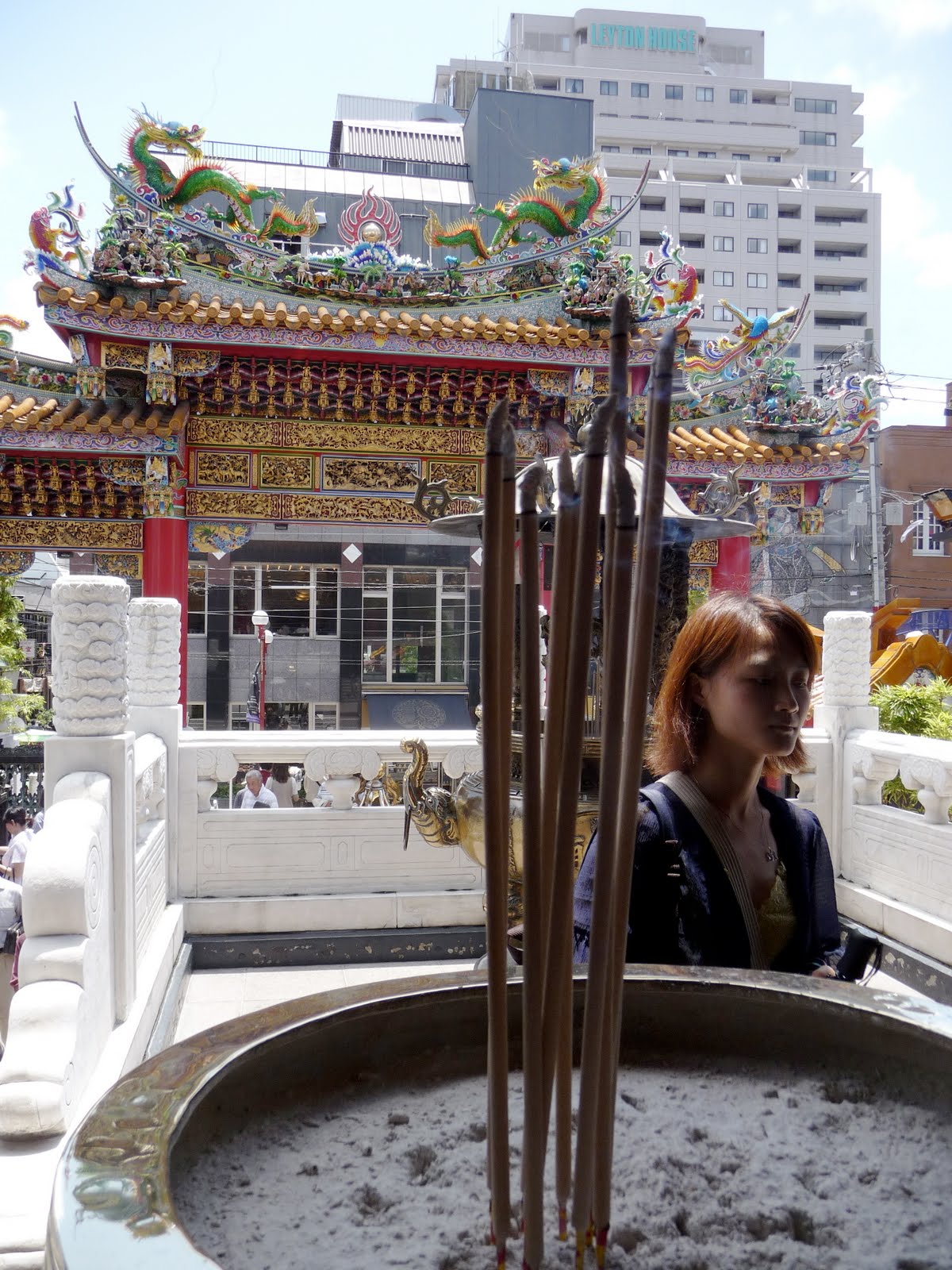 China Town
 Overlooking the port
A wonderful two weeks! I really enjoyed seeing more of Japan, especially as I've now accumulated enough Japanese to actually communicate with our hostel hosts and even random strangers. So much fun! I particularly remember one conservation with a Japanese man on the train down to Yokohama. I was trying to describe ARI and the work we do, but I only knew isolated words: yuuki nougyou o benkyoshimasu (study organic agriculture), gaijin gakusei (foreign students), tanbo (rice paddy)... I could tell he didn't really understand what kind of work I did, so finally I just told him that we had been working in the paddy that morning. His eyes widened - I could tell he was thinking, "What are a pair of foreigners doing working in a rice paddy in Japan??" Sometimes I wonder, too, about the strange and wonderful twists of fate that brought me to the paddies of ARI...
Thursday, June 3, 2010
8 months
In a way, I've now come full circle at ARI. Last week, we transplanted rice using the seedlings from the grains that I helped harvest last year during my first day of work. Comparing the "October Lizzie" to the "June Lizzie," I can sense many changes. In October, I was confused about the technical side of harvesting ("You want me to distinguish between normal rice and sticky rice? And what is sticky rice again...?"), and I felt a little at sea among the boisterous strangers of the ARI community. Now, eight months later, I helped coordinate the transplanting process, and I felt wonderfully comfortable working with people whom I now know as friends. I'm even starting to develop a love of rice - I crave onigiri (rice balls) wrapped in salty nori (seaweed), and I always have tamago-gohan (raw egg over rice with soy sauce - much more delicious than it sounds!) for breakfast on the weekends.
Here are some pictures from the community transplanting day, when the entire ARI community (volunteers, staff, and participants) got to wade into the paddies for some muddy fun.
 Zippo (India) with rice seedlings

 Participants transplanting

 The whole community!
I'll be away from ARI and from this blog until the end of June, as I'll be traveling around Japan with my boyfriend, Eric. We'll spend time in Okinawa, ARI, and Yokohama - expect a trip report soon...
Here are some pictures from the community transplanting day, when the entire ARI community (volunteers, staff, and participants) got to wade into the paddies for some muddy fun.
 Zippo (India) with rice seedlings
 Participants transplanting
 The whole community!
I'll be away from ARI and from this blog until the end of June, as I'll be traveling around Japan with my boyfriend, Eric. We'll spend time in Okinawa, ARI, and Yokohama - expect a trip report soon...
Monday, May 31, 2010
Je vous presente: John Nday

Meet John Nday: A 30-something community-development worker with the United Methodist Church OR from the Democratic Republic of Congo (DR Congo)- a tall, lean man with a quick smile and a gentle voice. Over the past two months, I've gotten to know John through our regular conversations en français (French is still the national language of the DR Congo, a living reminder of its colonial past) over dinner or in the field. I wanted to share some of his comments with you, hoping that learning more about one of the participants and his home context will make ARI a little more real to my readers at home. After all, ARI was created for the participants - you cannot really understand ARI and its mission without understanding the participants and their struggles.
Last year, John was selected by his employer, a Congolese branch of the United Methodist Committee on Relief called UMCOR-NGO, to participate in the ARI training program, an intensive nine-month course in sustainable, organic agricultural and in community development. UMCOR-NGO mostly works through micro-finance projects, providing funding and training for local, small-scale income-generation projects in villages throughout rural DR Congo. In all their projects, UMCOR-NGO development workers first meet with village representatives (or, if there is no preexisting representative group, ask that a village committee be formed) and ask them to decide, as a community, how to use the donated funds. UMCOR-NGO then provides basic training related to the project (practical training in agricultural skills or in sanitation techniques), with the goal of enabling the community members to independently manage the project once the UMCOR-NGO workers leave.
I asked John to identify some of the problems facing communities in his area. He described the chronic food and water shortages; the lack of health care or even basic sanitation facilities; the economic and psychological traumas caused by the civil wars that wracked Congo during the 1990s (many of the people who fled their homes almost 20 years ago are still afraid of going back - they now live in permanent-temporary communities in the countryside, "lacking almost everything"). But the biggest problem, according to John, "is poverty, because there are no factories, no industries around, so there are no job opportunities. For these people to survive, it's quite difficult. Most of the people are just farming. We have a lot of resources - we have a lot of land, we've got rivers and streams - but people still continue to suffer. The reason is a lack of knowledge, a lack of knowledge in agricultural skills. We set up projects to empower these people by teaching them agricultural skills." As a project manager, John specialized in agricultural projects that distributed seeds, tools, and food-processing equipment to struggling rural communities. He also led training sessions, giving demonstrations of different agricultural skills (from transplanting to plowing) and teaching communities how to process and sell the foods they produced (sunflower oil seems to be a particularly successful endeavor). Please see UMCOR's website for more details about their work in DR Congo.


Before coming to ARI, John had already studied agriculture at a university in Zimbabwe, but he said that the university program "trained us to become workers in big agricultural companies, maybe companies using chemicals. We cannot apply [that knowledge] to our small communities - where will they find the money to buy chemicals?" So in March, John left his wife and two infant sons in the DR Congo to travel to Japan for the ARI training course, which teaches the theory and practice of sustainable, organic farming. John says that he already finds finds the ARI training must more suited to local conditions than his university studies. "ARI training teaches us to do organic farming using local resources - using bokashi [organic fertilizer] or compost, things you can make." The focus of the training course is not on teaching specific technical skills, but on "teaching us how to think," as another participant said, so that participants can more effectively use their community resources - the people and materials available locally - rather than relying on imported products or imported solutions.
My conservations with John reminded me of an interesting article I read in this past April's National Geographic about water scarcity in northern Kenya. The article described the failed attempts of many-an-NGO to provide the villages of rural Kenya with reliable access to clean water:
"The villages of Konso [in northern Kenya] are littered with the ghosts of water projects past. In Konsos around the developing world, the biggest problem with water schemes is that about half of them fall into disrepair soon after the groups that built them move on. Sometimes technology is used that can't be repaired locally, or spare parts are available only in the capital... The 2007 survey of Konso found that only nine projects out of 35 built were functioning."But the article gave cause for hope, saying that some international aid groups are starting to change the way they implement development projects. "The real innovation," according to the article, "is [to treat] technology as only part of the solution. Just as important is involving the local community in designing, building, and maintaining new projects." ARI was built on the belief that sustainable social change, whether in Kenya or the Philippines or in Japan, must come through local community action rather than imported fixes. John's organization in DRC, UMCOR-NGO, operates on the same principles. Watching this class of participants learn and grow as leaders, I find hope for this world in the belief that they will go back and inspire their communities to develop in ways that are sustainable and appropriate to their local contexts.
Sunday, May 16, 2010
My garden

This is my garden, my own small piece of ARI land that I cultivated from the grass growing in front of the women's dorm. It measures about 4' by 6', and it's conveniently located just underneath my window (yup, that's my laundry drying in the picture). I planted beets about one week ago, and I'm also going to plant edamame (that green bean you often see at Japanese restaurants), chili, spinach, and bell pepper... which means I'll have to expand at some point. I'm hoping this tiny piece of land will supply me with enough veggies for weekend lunches during the summer months. Wish me luck!
Saturday, May 15, 2010
Summer revelries
Last weekend, some of the volunteers "went to Japan," as we like to say - in other words, we ventured off the ARI campus for a wonderful afternoon of Japanese hospitality (sushi! tea ceremony!) at a commuting volunteer's house, followed by a relaxing night of camping by a nearby river. What a way to start the summer!
The commuting volunteer, Ito-san, is a retired Japanese gentleman who lives up in the mountains surrounding ARI. His houses sits among small rice paddies, patches of bamboo forest, and 19th century family cemeteries - the perfect image of rural Japan. Before beginning our sushi feast, we got a tour of Ito-san's garden / home farm, where he grows onions, beans, taro, broccoli, cabbage, and other kitchen veggies on the quarter-acre of land surrounding his house. (Related side note: One of the striking things about Japanese development is the way the Japanese incorporate agricultural land into their towns and cities. Because land is very scarce, agricultural land is not separated from residential or commercial land the way it is in the U.S. - rice paddies abut major highways, family garden plots sit next to restaurants, even larger commercial farming enterprises can be found under overpasses or next to residential neighborhoods. It makes for an interestingly mixed landscape.) After the tour, we got down to the more important work of making and eating temaki-zushi, or hand-made sushi rolls, using nori (sheets of seaweed), sushi rice (white rice mixed with a little vinegar), slices of raw fish (tuna! mackerel! salmon!), wasabi, and pickled vegetables. And then, after three hours of eating and talking, Ito-san's wife performed a casual tea ceremony, offering us macha (powdered green tea) and seasonal mochi (rice cake) sweets. ほんとにおいしかたです (really delicious!).
After dinner, feeling wonderfully stuffed with fish, we drove down to one of the rivers around ARI and set up camp for the night. We pitched some tents (although one tent turned out to just be a rain cover... ahem), pulled some bamboo out from the woods for a fire, and settled down to an evening of talking, eating smoked garlic bread, and enjoying the warm summer night. Just like camping in the States, except we ate rice balls instead of bagels for breakfast.
 Mori (Japan)
 The view from our campsite
 Nami (Japan)
That weekend of eating and camping adventures made me realize how happy, how lucky I am to be at ARI. I love the people here, I love the lifestyle, I love the opportunity to learn new things every day. I hope you're also enjoying good food (maybe even sushi?) and warm summer nights with friends...
The commuting volunteer, Ito-san, is a retired Japanese gentleman who lives up in the mountains surrounding ARI. His houses sits among small rice paddies, patches of bamboo forest, and 19th century family cemeteries - the perfect image of rural Japan. Before beginning our sushi feast, we got a tour of Ito-san's garden / home farm, where he grows onions, beans, taro, broccoli, cabbage, and other kitchen veggies on the quarter-acre of land surrounding his house. (Related side note: One of the striking things about Japanese development is the way the Japanese incorporate agricultural land into their towns and cities. Because land is very scarce, agricultural land is not separated from residential or commercial land the way it is in the U.S. - rice paddies abut major highways, family garden plots sit next to restaurants, even larger commercial farming enterprises can be found under overpasses or next to residential neighborhoods. It makes for an interestingly mixed landscape.) After the tour, we got down to the more important work of making and eating temaki-zushi, or hand-made sushi rolls, using nori (sheets of seaweed), sushi rice (white rice mixed with a little vinegar), slices of raw fish (tuna! mackerel! salmon!), wasabi, and pickled vegetables. And then, after three hours of eating and talking, Ito-san's wife performed a casual tea ceremony, offering us macha (powdered green tea) and seasonal mochi (rice cake) sweets. ほんとにおいしかたです (really delicious!).
After dinner, feeling wonderfully stuffed with fish, we drove down to one of the rivers around ARI and set up camp for the night. We pitched some tents (although one tent turned out to just be a rain cover... ahem), pulled some bamboo out from the woods for a fire, and settled down to an evening of talking, eating smoked garlic bread, and enjoying the warm summer night. Just like camping in the States, except we ate rice balls instead of bagels for breakfast.
 Mori (Japan)
 The view from our campsite
 Nami (Japan)
Sunday, May 2, 2010
A taste of ARI

Last week, I finished my second month of kitchen duty - which means that for almost a third of my time here, I've helped make breakfast and dinner every day for the entire ARI community. ARI food is a unique combination of cuisines, informed by the personal tastes of our participants and volunteers and by the selection of ingredients we have on hand (right now that means tons of carrots - so we eat carrots at every meal). During my two months in the kitchen, I've learned that recipes are overrated, that "curry" means a dozen different things to a dozen different participants, and that almost everything tastes better when you add a little cooking sake. To give you a little taste of ARI cooking, I've included four recipes for a typical ARI dinner below. The quantities listed are roughly for four people, but beware - I made up the quantities, since we usually cook for around 60 people, and we never measure anything.
Sri Lankan carrot stir-fry
- Carrots, peeled and cut julienne (into small sticks)
- 1 onion, cut julienne
- Olive oil
- 4 cloves of garlic, minced
- Turmeric
- Garam masala
- Chili (either powder or whole, to your spice tolerance - Sri Lankans like it hot)
- Salt
- Sauté the onions and garlic in oil for 3 to 5 minutes, until the onions become translucent.
- Add generous amounts of turmeric and garam masala, and sauté for 2 to 3 minutes to bring out the flavor of the spices. If you wish to add chili, add with the other spices.
- Add the carrots. Continue to sauté until the carrots are tender.
- Adjust spices and salt to taste, and serve.
- 2 lbs. pork, chopped into cubes
- 1/2 lbs. potatoes, chopped
- 1/2 onion, diced
- 1/2 cup soy sauce
- 1 cup vinegar
- 2 cups water
- 1 teaspoon paprika
- 5 laurel leaves (bay leaves)
- 2 tablespoons minced ginger
- 1 head garlic, minced
- 4 tablespoons olive oil
- 2 tablespoons cornstarch
- Salt, black pepper to taste
- 3 tablespoons of water
- In a big sauce pan or wok, heat 2 tablespoons of oil then sauté the minced garlic, ginger, and onions.
- Add the pork and the potatoes to the pan. Add 2 cups of water, 1/4 cup of soy sauce, vinegar, paprika and the bay leaves. Bring to a boil. Cover and simmer for 30 minutes or when meat is tender and potatoes are cooked.
- Remove the pork from the sauce pan and on another pan, heat cooking oil and brown the pork for a few minutes.
- Mix the browned pork back to the sauce and add cornstarch dissolved in water to thicken.
- Add salt and pepper if desired
- Bring to a boil then simmer for an additional 5 minutes.
- Serve hot with the adobo gravy and rice.
- Hard (momen) tofu, cut into large cubes
- Soy sauce
- Mirin (sweet cooking sake)
- Garam masala
- Turmeric
- Flour
- Baking soda
- Prepare a half-and-half mixture of soy sauce and mirin, and add a generous quantity (several tablespoons) of garam masala and a little turmeric.
- Briefly marinate the tofu cubes in the sauce
- Coat the tofu with a half-and-half mixture of flour and baking soda.
- Deep-fry and serve, either plain or over rice.
- Sweet potatoes (or potatoes or yams), cut into bite-sized pieces
- Carrots, thinly sliced
- Shitake mushrooms, sliced
- Komatsuna (any leafy green vegetable will do - spinach, cabbage, etc.), in large pieces
- Miso paste
- Fill a pot with enough water for four servings of soup. Add the prepared sweet potatoes and carrots, and bring the water to a boil.
- After the carrots and potatoes are fully cooked, add the shitake mushrooms.
- After the mushrooms are tender, add the leafy green vegetable. Cook for about 1 minute, then turn off the heat (careful - if you cook leafy vegetables too long, they will wilt).
- Immediately add the miso paste to taste by stirring the miso into the soup through a strainer. Place the miso in a strainer, then hold the strainer over the soup so that the miso is just submerged - using a wooden spoon, stir the miso until it dissolves. (Miso will lose its flavor if cooked too long, so make sure to add the miso right before serving.)
- Serve immediately.
Subscribe to:
Posts (Atom)


 Posts
Posts

